Mining
Lindian Resources is advancing construction and community support projects side by side at Kangankunde
November 11, 2026 / Admin
Lindian Resources is advancing construction and community support projects side by side at Kangankunde
Kangankunde Rare Earth Mine is making good progress towards its next stage, with the key infrastructure required for commissioning now in place. The final stages of construction and commissioning are targeted for December 2026.
While construction moves forward, Lindian Resources has not forgotten the people living around the mine. Alongside construction, the company has continued to invest in infrastructure that addresses people’s needs and strengthens its relationship with the communities around Kangankunde. The project has invested in education, employment and skills development, and the results of this work can already be seen on the ground before any revenue is generated.
Investing in education and early learning
One of the project’s key community initiatives is Project Early Learning at Kangankundi Primary School, which serves approximately 400 learners.
Working hand in hand with the Ministry of Education, Lindian Resources has invested over $1m rebuilding the Kangankundi Primary School. The project has allowed the refurbishment of two existing classroom blocks and the teachers’ office block and allowed for construction of four additional classroom blocks, a sick bay, a netball court and a fence around the primary school, giving both learners and teachers a better and safer place to learn and work.
To accommodate pre-primary learners, two classroom blocks were built for pre-school children aged two to five years. Evidence shows that early learning is crucial for brain development and for an easy transition to, and success in, primary school. However, in Malawi access to early learning is at 34 per cent, making the inclusion of pre-primary learning facilities a very important part of this project. Today these two classrooms are full of young learners, with over 100 children attending pre-school every day.
To ensure that teaching and learning take place in a safe environment, the project constructed and fixed water, sanitation and hygiene facilities at the school. These include modern toilets, girls’ changing rooms and the repair of the broken borehole, which is the school’s source of water. With the borehole fixed, the school once again has its own water supply.
For those interested in sports, the school now has a new netball court that comes with a supporters’ stand for cheering on the players.
Improving access and community safety
Beyond the school, the mine has invested in improving road access to Malawi’s main highway, the M1 Road. Improved road access matters not only for moving mining equipment and supplies, but also for residents who need to reach essential services such as health facilities and trading markets.
Kangankunde is situated approximately six kilometres from the M1. Before the project constructed its access road, the community had challenges accessing this highway.
The new road improves access between Kangankunde and the wider transport routes to Balaka town, where the local government offices and the District Hospital are found. It also opens up Kangankunde to Blantyre and Lilongwe districts, two of the three main business hubs in Malawi, bringing new possibilities for trade and movement for the people of the area.
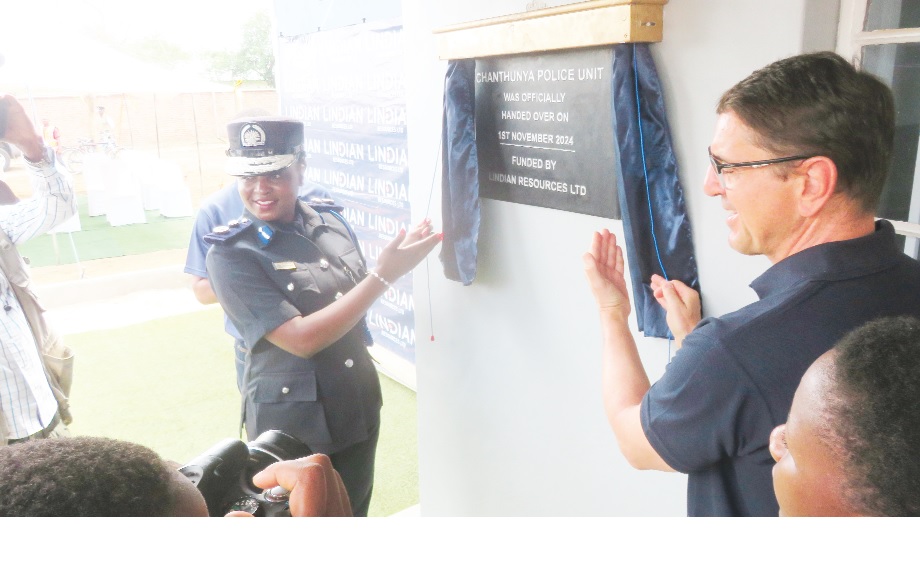
The project has also invested in community safety. Residents in Traditional Authority Chanthunya showed great commitment by mobilising their own resources to construct a police unit, but were unable to complete it due to financial constraints. Lindian stepped in and supported the completion of the police unit, which was officially opened by the Eastern Region Commissioner of Police, Barbara Mchenga Tsiga, on 1 November 2024. In the words of Senior Traditional Authority Inkosi Chanthunya, having police presence in the area has strengthened safety.
Creating opportunities for Malawians around the mine
Employment and skills development are also becoming increasingly important as the project expands its operations.
In total, including contractors, there are over 3,500 people employed at Kangankunde, over 90 per cent of whom are Malawian nationals. Some of them come from the 15 Group Village Heads (GVHs) that surround the mine, highlighting the importance of nearby communities to the project’s workforce and showing that the benefits of the mine are reaching the people who live closest to it.
The expatriate staff at the mine are there in specialised positions where skills are not yet readily available locally. Part of their role is to work alongside Malawian colleagues and transfer their skills, so that over time more of these specialised positions can be filled by Malawians.
For some employees, these opportunities have meant acquiring new skills or moving into positions that better reflect the qualifications they already have.
Take Grace Kaliati for instance, who comes from Sanudi Village near the mine. She joined the project as a security guard in February 2026. When a mechanical position became available, she applied and moved into a mechanic’s role, putting to good use the certificate in mechanics she obtained from Andeamo Technical College in Balaka. Grace’s story is a good example of how local people, including women, are getting the chance to grow into technical roles at the mine.
The project has also created opportunities for local professionals to develop their careers while contributing to the training of others. Ekari Muriya, a qualified surveyor, works as a middle manager at Kangankunde. He trains and supervises a team of six people from communities around the mine, with himself working under the supervision of an experienced mining professional with global expertise. In this way, skills are being passed on from one level to the next.
Ekari works with Thoko Magombo, who joined the mine as a gardener but now works as a trainee surveyor and is her team’s safety champion.
The figures illustrate the contribution of the mine’s development phase to local employment. They also highlight the importance of creating pathways through which Malawians can acquire technical skills and progress into more specialised roles, and the stories of Grace, Ekari and Thoko show that these pathways are already working.
Empowering women through culture and enterprise
Women’s empowerment and cultural preservation are also part of the project’s community engagement efforts.
On 6 September 2026, the project’s Community Relations team launched the first Kangankunde Women Cultural Group under Group Village Head Makolera. Approximately 50 women attended the launch, marking the beginning of an exciting initiative that will expand into five group village heads.
The group aims to create opportunities for women to participate more actively in community development activities and to preserve local culture, while strengthening relationships between the mine and its host communities. Through this group, the women will access financial literacy, health, nutrition and awareness programmes.
At the inaugural meeting, participants shared ideas on ways of generating income through home-run businesses in response to the growing economic activity brought in by the mine, a clear sign that the women are ready to take up the opportunities around them.
The initiative aligns with the mine development’s Social Performance Plan, which seeks to build long-term relationships with host communities and to encourage local participation in the opportunities associated with the project.
Bringing services closer to the people
As Kangankunde continues to grow, economic activities around the mine are also expanding. This has created the need to bring banking services closer to the mine.
Kangankunde mine is therefore collaborating with NBS Bank to open a service agency at the mine. This will help to bring previously unbanked people into the formal banking system and will reduce the travel time needed to access banking services by 1 hour 30 minutes.
Additionally, NBS Bank plans to introduce financial literacy lessons for staff at the mine and interested community members, such as the women’s cultural groups. Targeting newly recruited staff members, especially those recruited from the community, is important, as this is the first time many of them are earning a consistent income.
Project and community development side by side
It is pleasing to see a company such as Lindian Resources implementing programs that directly benefit the community its people and uphold its traditions, hopefully other aspiring miners will take note of their early and substantial investment into their community that they have made and we hope that Lindian will keep their long-term goals in place and continue to progress side by side with the community around Kangankunde mine.
For the communities surrounding the mine, Senior Traditional Authority Inkosi Chanthunya says they will measure progress by the long-lasting opportunities created for the people who live nearby and across Malawi. What has been achieved so far gives a strong foundation for that journey.
Share this:
Leave a Comment
Comments
Mining & Trade Review News

Agribusiness News

Subscribe to Newsletter
Rehabilitation:
The establishment of a stable and self-sustaining ecosystem, but not necessarily the one that existed before mining began. In many cases, complete restoration may be impossible, but successful remediation, reclamation, and rehabilitation can result in the timely establishment of a functional ecosystem.
Archives
Remediation:
The cleanup of the contaminated area to safe levels by removing or isolating contaminants. At mine sites, remediation often consists of isolating contaminated material in pre-existing tailings storage facilities, capping tailings and waste rock stockpiles with clean topsoil, and collecting and treating any contaminated mine water if necessary.
Stakeholders Logos